


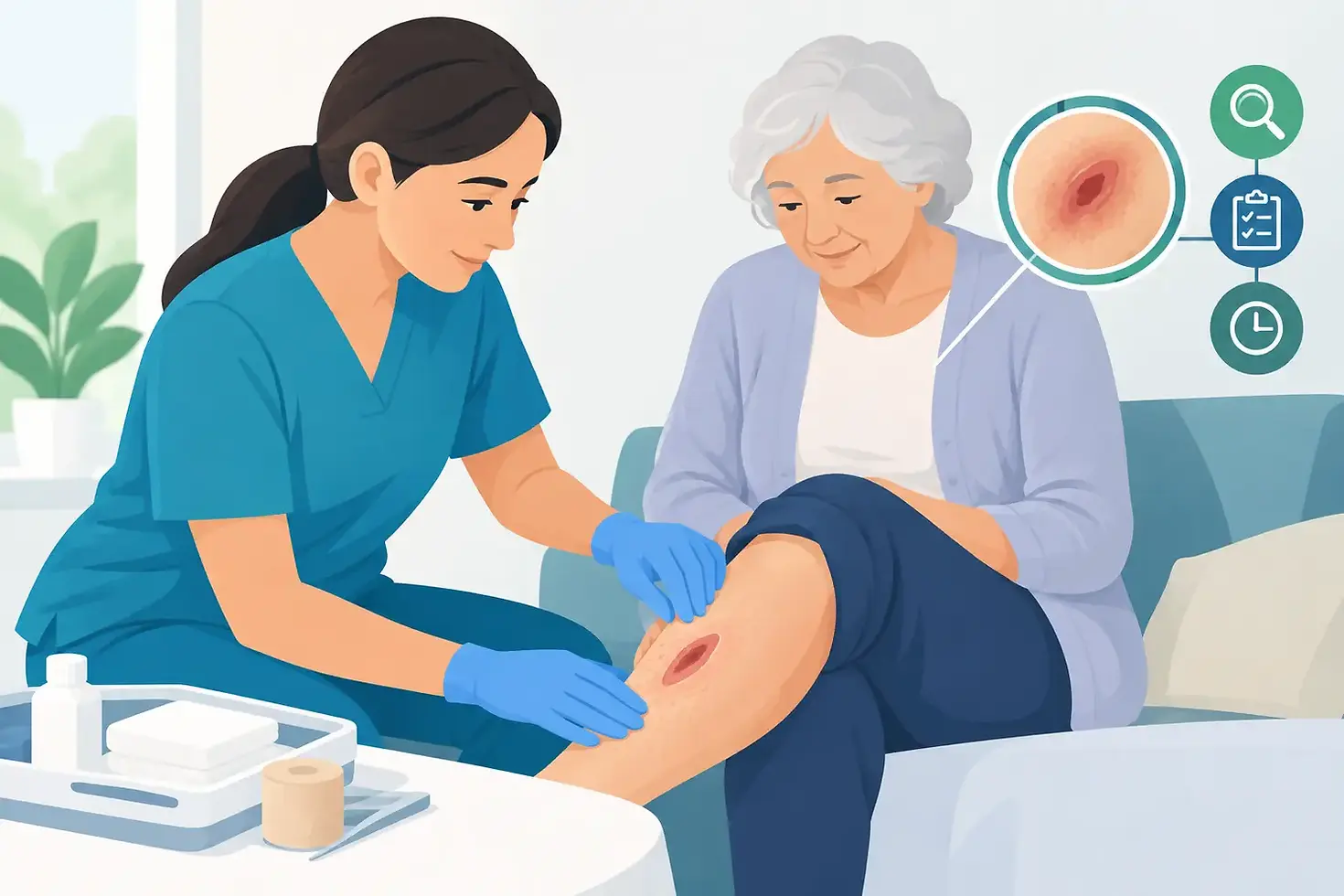
Caregiver Wound Assessment Guide for Fast Action

A dressing that looked dry in the morning can become soaked, painful, or foul-smelling by evening. For a caregiver, noticing that change early can help prevent a small concern from becoming an infection, emergency department visit, or prolonged healing delay. This caregiver wound assessment guide explains what to observe between professional visits, what to document, and when to call the wound care team.
Caregivers play an essential role, especially for older adults, people with diabetes, patients recovering from surgery, and individuals with limited mobility. Your role is not to diagnose the wound or replace clinical treatment. It is to recognize meaningful changes, protect the treatment plan, and get the right help quickly.
Caregiver Wound Assessment Guide: Start With the Whole Person
A wound should never be assessed in isolation. A patient may appear more tired than usual, have less appetite, report new pain, or become confused before the wound itself shows obvious warning signs. These changes matter, particularly for medically vulnerable adults who may not develop a high fever even when an infection is present.
Start by asking how the patient feels. Is their pain new or increasing? Are they avoiding walking, shifting position, or allowing a dressing change because the area hurts more? Have they had chills, nausea, weakness, dizziness, or a noticeable change in alertness? If the patient has diabetes, changes in blood sugar can also affect healing and may warrant a call to their medical provider.
Then observe the wound during the scheduled dressing change or when the care plan permits. Follow the instructions provided by the treating clinician. Do not remove a dressing early, probe the wound, or use products that were not ordered just to get a better look. Some advanced dressings and grafts need to remain undisturbed for a specific period to support healing.
Prepare Before Looking at the Wound
Good assessment begins with clean technique. Wash your hands thoroughly before and after wound care, use gloves when instructed, and prepare supplies on a clean surface. Keep pets away from the care area, and avoid placing dressings or supplies on bedding, countertops, or clothing.
Good lighting is helpful. If the clinician has asked you to take wound photographs, use the same lighting, distance, and angle each time. Only photograph the wound if it is part of the care plan and privacy is protected. A consistent record is more useful than a single image taken in poor light.
What to Observe and Record
A brief daily note can help a wound care provider identify a trend. Record observations after each dressing change, or at the frequency directed by the care team. You do not need clinical terminology. Clear, factual descriptions are best.
Pay attention to these five areas:
Drainage: Note the amount, color, thickness, and odor. A small amount of clear or light yellow drainage may be expected for some wounds, but a sudden increase, thick drainage, green drainage, or a strong odor should be reported.
Surrounding skin: Look for spreading redness, warmth, swelling, rash, blisters, darkening skin, or skin that feels unusually firm. For pressure injuries, new discoloration over a bony area can be an early warning sign.
Wound appearance: Observe whether the wound seems larger, deeper, drier, wetter, or different in color. Healthy healing tissue is often moist and pink to red, but each wound is different. Black tissue, new yellow buildup, or a sudden change in appearance needs clinical review.
Pain: Record where the pain is, how severe it is, and whether it happens at rest, during movement, or with dressing changes. Increasing pain can signal pressure, infection, poor circulation, or a dressing problem.
Dressing condition: Note whether the dressing is clean, dry, secure, and intact. A dressing that is loose, saturated, leaking, or contaminated may need attention sooner than the next scheduled change.
Include the date, time, and any action you took, such as repositioning the patient, elevating the legs as directed, or calling the nurse. These notes help clinicians make better decisions during home visits, office appointments, and care coordination calls.
Know What May Be Expected and What Is Not
Healing wounds do not always look better every day. Some chronic wounds heal slowly, and certain treatments can temporarily change drainage levels or the wound bed appearance. For example, debridement may leave the wound looking larger immediately afterward because nonviable tissue has been removed. This is why comparing the wound to a single previous day can be misleading.
The more useful question is whether the overall plan is moving forward. Is the wound being measured by the clinician? Is drainage becoming more manageable? Is pain controlled? Is the patient able to protect the area from pressure, friction, or moisture? When the answer is no, the care plan may need adjustment.
Pressure injuries require special attention to positioning. A sacral wound will struggle to heal if the patient remains in one position for extended periods, while a heel wound can worsen if the heel rests continuously against the mattress or recliner. Follow the offloading and repositioning schedule prescribed by the care team. Pillows, support surfaces, footwear, and mobility plans must be used correctly to reduce repeated pressure.
For venous leg ulcers, compression may be a central part of healing, but it should only be used as ordered. For diabetic foot ulcers, keeping pressure off the foot may be just as important as the dressing itself. Do not assume that a product or technique that helped one type of wound is appropriate for another.
Call the Wound Care Team Promptly for These Changes
Contact the treating clinician or wound care provider the same day if you notice increasing redness around the wound, new warmth or swelling, worsening pain, a sudden increase in drainage, a new or strong odor, or drainage that becomes thick or pus-like. Call promptly if the wound appears larger or deeper, the surrounding skin breaks down, the dressing repeatedly becomes saturated, or a graft, packing material, or other ordered treatment becomes displaced.
A call is also appropriate when the patient cannot follow the care plan because of pain, confusion, mobility changes, incontinence, transportation barriers, or lack of supplies. These are not minor logistics. A missed dressing change or inability to offload pressure can quickly affect healing.
For people with diabetes, do not wait on a new blister, cut, color change, swelling, or drainage on the foot. Diabetic foot wounds can worsen quickly, sometimes with less pain than expected due to neuropathy. Early evaluation helps protect tissue and reduce the risk of serious infection.
Seek Emergency Help When Symptoms Are Severe
Call 911 or seek emergency care for severe or uncontrolled bleeding, trouble breathing, chest pain, fainting, sudden severe confusion, blue or gray skin, or signs that the patient is acutely very ill. Urgent medical evaluation is also needed for rapidly spreading redness, red streaks moving away from the wound, high fever, shaking chills, or severe pain that is new and out of proportion to the wound’s appearance.
If you are unsure whether a symptom is urgent, it is safer to contact the clinical team immediately. A caregiver should never feel they must make a difficult decision alone.
Protect Healing Between Visits
The most effective caregiver support is often consistent, simple care. Keep dressings clean and in place, maintain the clinician’s turning or offloading plan, support nutrition and hydration when medically appropriate, and help the patient take prescribed medications as directed. Encourage them to report pain rather than trying to push through it.
Avoid home remedies, peroxide, alcohol, unapproved ointments, or adhesive products unless specifically ordered. These can damage healthy tissue, interfere with advanced therapies, or irritate fragile skin. Do not trim dead tissue, remove staples or sutures, or pack a wound differently than instructed.
It also helps to bring a current medication list, blood sugar records when relevant, and your wound notes to each visit. If multiple family members or facility staff provide care, use one shared record so observations do not get lost between shifts.
Professional Assessment Brings the Full Picture
Some wounds need more than routine dressing changes. A clinician may need to assess circulation, pressure relief, infection risk, nutrition, diabetes control, or whether advanced treatment options such as debridement, biologic grafts, non-thermal ultrasound, VHT therapy, or hyperbaric oxygen therapy could support healing. The right approach depends on the wound type, location, cause, and the patient’s overall health.
Wound Care Center of Palm Beach provides expert wound care through office-based and mobile services, helping eligible patients receive physician-led evaluation and advanced treatment in the setting that best supports them. For caregivers, timely communication can make those services more effective and help reduce unnecessary hospital disruption.
A careful observation today is not overreacting. It is practical, protective care. When a wound changes, document what you see, follow the existing treatment instructions, and request professional guidance without delay. That steady attention gives the patient a stronger path toward comfort, healing, and recovery.


Comments